.jpg)
Does modern wheat leave you feeling bloated? Or maybe the symptoms are more subtle like joint inflammation, brain fog, digestive upset and so many other possibilities. There is a reason for that. If you haven’t already made the connection to the way your body is feeling, to what you are eating, it is time to start paying attention. Wheat, dairy, and sugar are the top three offenders when it comes to inflammatory responses within the body. Eliminate the offenders and you decrease or eliminate the inflammation.
Unfortunately, we do not spend enough time talking about the food we put in our bodies, but it should be something that we are not only talking about but teaching our children and grandchildren. The healthy habits we create today will reduce the possibility of disease experienced in the future. As Hippocrates (460-370 BC) stated, “let food be thy medicine and medicine be thy food.” But what he couldn’t predict at the time is the amount of plant adulteration, either due to genetics or chemicals, that our society would be faced with. Eliminating EDC’s (endocrine disrupting chemicals) and GMO's (genetically modified organisms) from the diet is not only important but a rather daunting task in today’s world.
One way you can focus on this transition is to remove modern wheat from the diet and incorporate ancient Einkorn grain. This transition is safe for most people who have mild digestive upset or gluten intolerance but is not recommended for those with Celiac Disease. If you are unsure if this transition would be recommended for your personal health improvement, you can always book in with Holistic Health – Inspired by Nature for further assistance.
Now, let’s compare modern wheat to einkorn and see where the differences lie. Modern wheat contains 42 chromosomes and is a hexaploidy (hexa=6 sets of chromosomes) wheat. That means it has been modified from its original version to be shorter, mature earlier, higher gluten structures, increased grain size, heat and drought tolerant, and the list goes on. All these modifications to keep up with global demand. Yet, we have forgotten the most important part. Is all this modification good for us? Can our bodies digest this food? Is it still something are bodies even recognize? The answer is no and that is one of the reasons we are seeing an increase in digestive orders such as heartburn, indigestion, bloating, GERD (Gastro-esophageal reflux disease), leaky gut and a whole host of symptoms.
After World War 2, synthetic herbicides were produced in increasing number. If there was an issue, there was a chemical that would control that issue. Today, modern wheat is sprayed with herbicides to kill the offending weeds or used to speed the ripening process in the fall so that all the grains mature at relatively the same time. This ensures that there will be no “green count” dockage for the farmer, creating best yields possible. Then, the farmer hauls his wheat to the grain elevator where it will be sent for processing and turned into flour. During processing, additives such as bleaching agents like benzoyl peroxide, chlorine dioxide, and ascorbic acid are used to whiten and brighten the flour. Preservative such as calcium propionate and sodium benzoate are added to prevent mold and bacterial growth and improve long-term storage. Enriching agents such as synthetic vitamins and minerals like folic acid, niacin, thiamine mononitrate, riboflavin, iron and pantothenic acid are added to replace the nutrients that are stripped from the grain during processing. Finally, conditioning agents that include enzymes, emulsifiers, and additional gluten are added to improve dough elasticity, moisture retention and product texture. Even if choosing organic grown wheat, that wheat has been modified to become a better version than the original grain. If all this makes you feel a bit queasy then let’s look at the alternative.
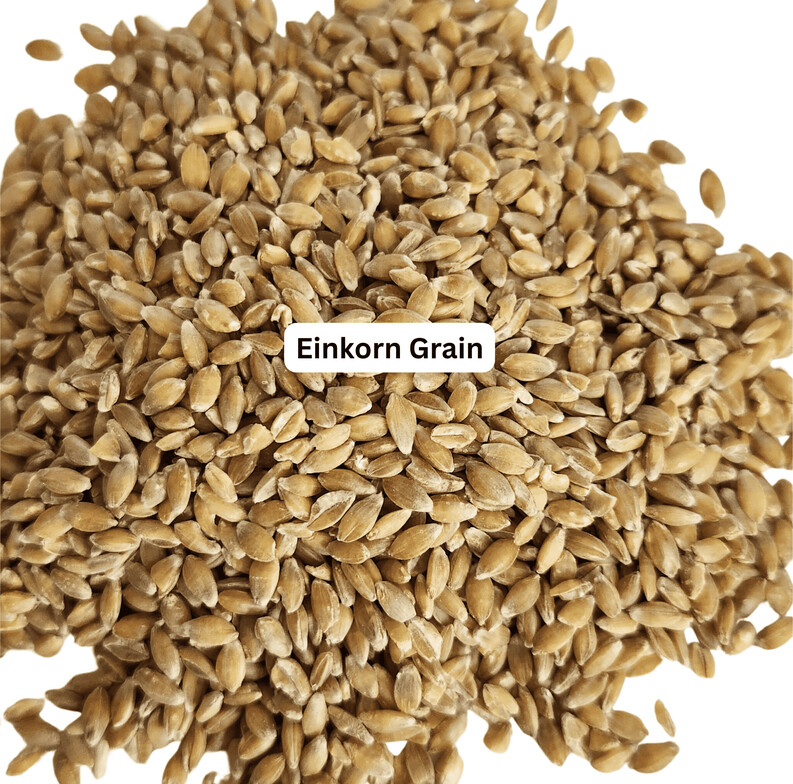
One of the great ancient grain alternatives is Einkorn. Einkorn is a non-hybridized ancient grain known to be the first cultivated grain historically. It contains 14 chromosomes and is a diploidy (two sets of chromosomes) wheat. Einkorn still contains gluten, but it contains a different kind of gluten compared to modern wheat. Einkorn grain contains the A genome of gluten rather than the D genome found in modern wheat, which means that it is easier to digest and may reduce gut inflammation in some individuals. Most Einkorn grain is grown by organic producers, therefore rendering it free from chemical sprays. Einkorn is higher in protein, iron, dietary fiber, essential vitamins, minerals, antioxidants and fatty acids compared to modern wheat. Einkorn is rich in lutein and beta-carotene, both phytonutrients that can be protective of eye health. And, if Einkorn grain is sprouted prior to use, it increases the amount of beta-carotene present. Einkorn contains phenolic acid, a natural antioxidant that can reduce damage to cells and reduce inflammation. Einkorn may increase bacteria that produce short-chain fatty acids and increase the metabolic diversity of the gut. Short-chain fatty acids can reduce gut permeability (leaky gut) by reducing the risk of toxins (ama) entering the blood stream. Einkorn has a low glycemic index which helps to regulate blood sugar. Even though Einkorn is a healthier choice, all grain products should be eaten in moderation. Furthermore, if you purchase the grain whole, called Einkorn berries, it can then be ground in a home mill, Vitamix or high speed blender, avoiding any chance of additives. If purchasing packaged Einkorn flour, then you might want to make sure that the product your purchasing is what you are expecting. When in doubt, ask questions. Proud producers love to tell you about their product and how it's made.
Like most prairie people I have roots in farming. My father was a farmer, my brother was a farmer, and my husband is a farmer. Farming is not an easy profession, and it isn’t getting any easier. With its emotional, financial and environmental toll, it has a significant impact on farming families. I truly hope that the farmers of the future will endeavor to try sustainable, environmentally friendly, regenerative forms of farming that incorporate ancient grains. Satisfying the world wheat market is no easy task as our modern society is obsession with grain products. The change must begin with us, the consumers. We must be the change that we want to see in the world and live that change. Consider making small changes to your diet that may have a huge impact on your health and wellbeing. Support small local farmers who are choosing to step outside the box and do things differently. To those farmers, I commend you. If you are looking for a small local farmer who grows ancient Einkorn grain, I suggest you look up prairiegenesis.ca.

Lorie Schell
Contact Me